9 min
Lost at the top of every call
A twelve-person leadership meeting that starts nine minutes late every week costs more in a year than the room cost to build.
Unified communications · Singapore
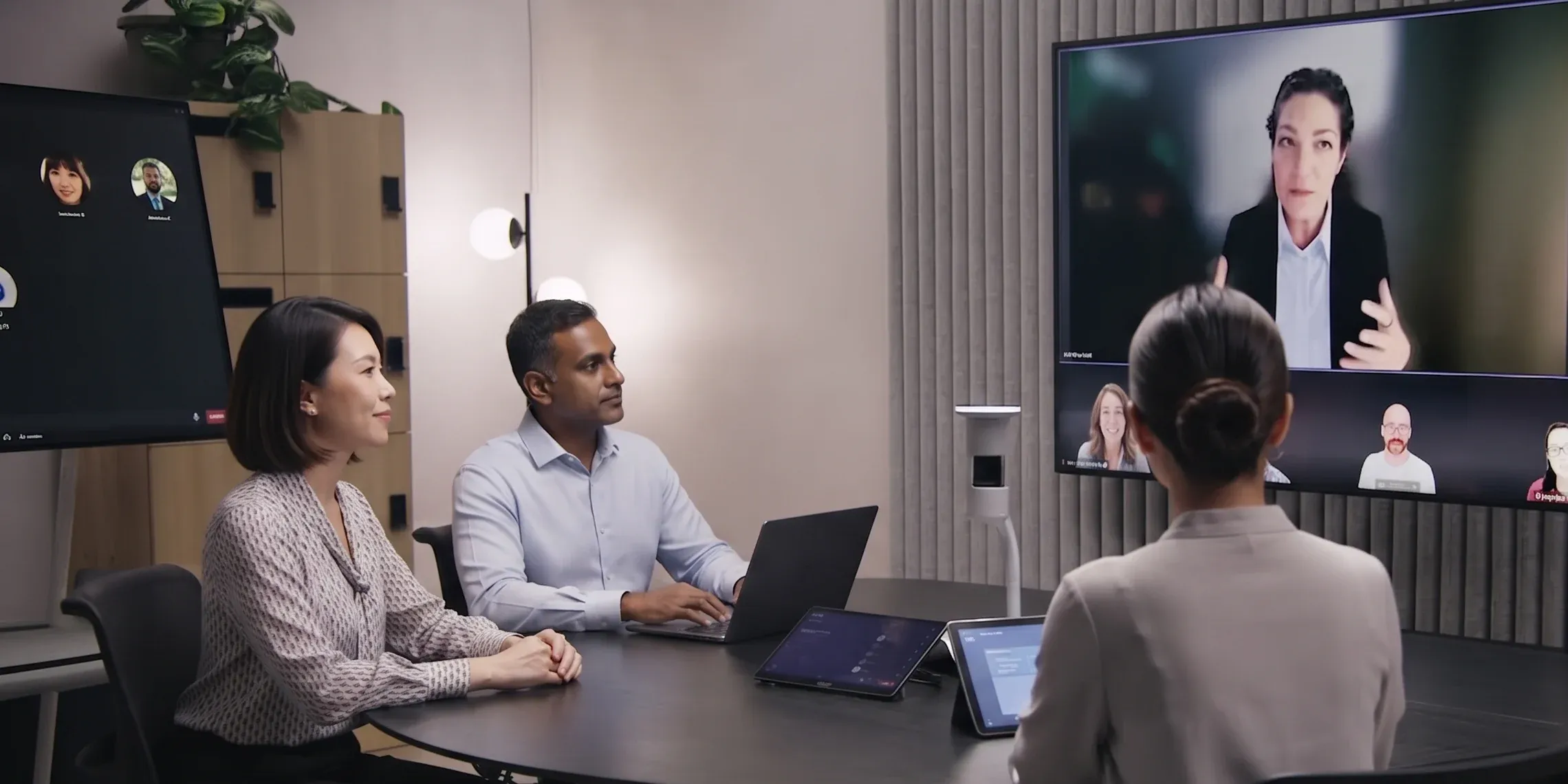
Someone cannot be heard. The screen will not wake. The call starts five minutes late, again. It is almost never the platform — it is the room it was installed in.
VisionCast designs, installs and supports meeting rooms across Singapore. We carry ten manufacturers and are owned by none of them, so the recommendation you get is the one that fits your room.
The problem
Yet that is the single most common complaint we are called in to fix — and almost never because the organisation bought cheap hardware.
9 min
A twelve-person leadership meeting that starts nine minutes late every week costs more in a year than the room cost to build.
1 in 3
Once a room has a reputation for failing, staff stop booking it. You paid for capacity that now sits empty while the good room runs at 100%.
#1
Remote participants forgive a soft picture. They do not forgive not being able to hear. Microphone coverage is where rooms are most often under-specified.
Two ways to buy the same room
| Decision | Bought as a bundle | Designed for the room |
|---|---|---|
| Procurement | A bundle picked off a price list | A design derived from the room and the platform |
| Audio | One device, wherever the table had power | Coverage modelled against seating, ceiling height and finishes |
| Platform | Whatever the hardware happened to certify for | Chosen around the stack your organisation already runs |
| Controls | Different in every room, so nobody trusts any of them | One identical, learnable control surface estate-wide |
| After handover | A warranty number and good luck | Remote monitoring, a named engineer, a contracted response |
What "unified" actually means
Unified communications is not a product you buy. It is the state you reach when calling, video, chat, content and scheduling all resolve to the same person, on the same directory, with the same controls.
Most organisations are already part of the way there and do not know which part is missing. That gap is usually where the meeting-room experience breaks down.
The bench
A single-brand integrator has one answer to every room. We would rather hold the range and recommend the one that fits the space in front of us — including when that is the cheaper option.

Native Teams and Zoom room systems with a consistent touch console across the range.

One interface from huddle room to boardroom, with strong remote management at scale.

Collaboration panels and UC devices where annotation matters as much as the call.

Ceiling and table arrays with steerable lobes for hard surfaces and long tables.

ADECIA auto-tunes mic, processor and speakers to the room, cutting commissioning time.

Enterprise audio processing for auditoria, divisible rooms and multi-zone spaces.

Matrix switching, signal distribution and control for rooms with many sources.
Boundary and ceiling microphones for chambers, lecture halls and formal rooms.

4K 360-degree cameras for spaces with no fixed install and no IT presence.

Practical room systems for deployments where budget per room is fixed.
Standardised on something we do not carry? Tell us what it is — if it is right for the room we will work with it, and if it is not we will explain why.
Ask about a brandSpecifying against the room, not the catalogue, occasionally means telling a client the cheaper device is the right one. That is the trade we made when we chose not to be owned by a manufacturer.
How we choose
Most failed rooms we are asked to rescue were specified backwards — hardware first, room last. This is the sequence we work in, and what you get at each stage.
Dimensions, seating, ceiling height, glazing and wall finishes. A glass-walled room and a carpeted one with identical floor plans need entirely different audio.
Deliverable — site survey with coverage plan
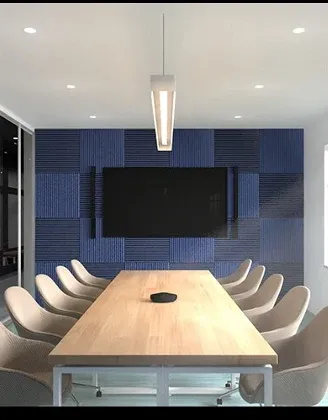
Teams, Zoom, Webex or Meet. The certified path differs for each, and buying hardware before settling this is how rooms end up unsupported.
Deliverable — platform and licensing position
Not the seat nearest the microphone. If the person at the far end of the table is intelligible to a remote participant, everyone else already is.
Deliverable — mic coverage and camera framing plan
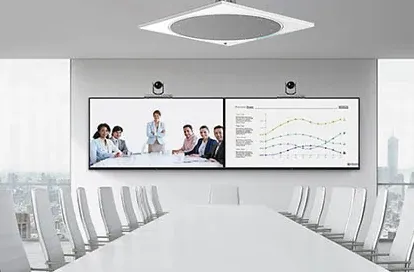
Identical controls in every room, whatever sits behind the wall. Nobody should have to learn a second room.
Deliverable — control standard and user guide
Remote monitoring, firmware management, a named engineer and a contracted response time. Rooms drift; someone has to own that.
Deliverable — support agreement and monitoring dashboard
Rooms
Room type drives almost every decision that follows it — camera field of view, microphone pickup pattern, whether you need a DSP at all.
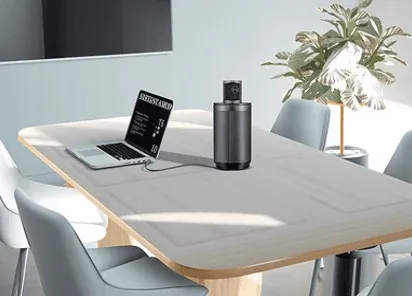
One device, one cable, no in-room IT. The bar covers camera, microphone and speaker for the whole space.
All-in-one bar · single display · USB or native
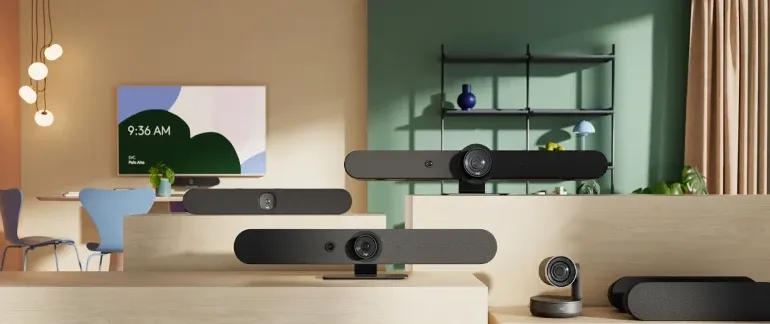
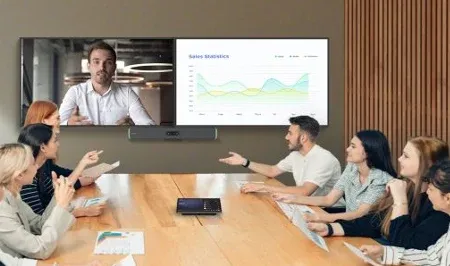
Where most of your calls actually happen. Framing and microphone reach have to cover the whole table, not the first two chairs.
Video bar · touch console · booking panel
The room your clients and board see. Engineered audio, intelligent camera switching, and controls simple enough that nobody needs briefing.
Ceiling array · DSP · dual display · PTZ
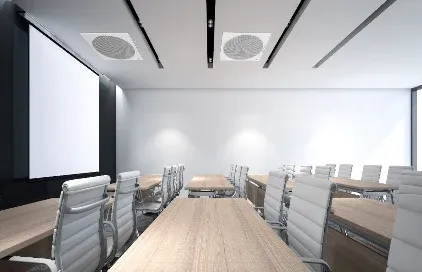
Presenter reinforcement, audience microphones and content capture, so remote attendees get the same session as the room.
Reinforcement · lapel/handheld · capture
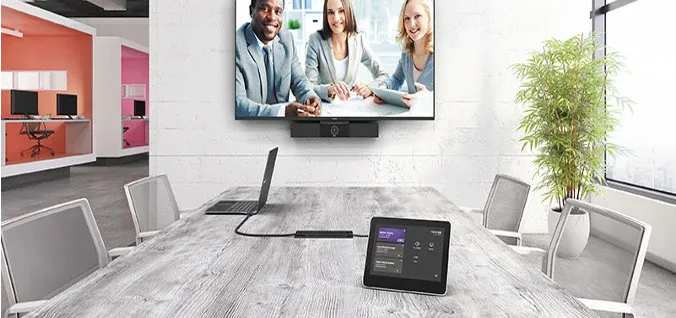
Bookable pods and open areas where people drop into calls without a booking, a cable or a helpdesk ticket.
Portable systems · BYOD · wireless share
One standard, deployed repeatedly, monitored centrally. Consistency is the point — every room behaves the same way.
Room standards · staged delivery · monitoring
Platforms
Each of these has a different certified device list. Buying first and deciding second is the most expensive order to do this in.
Already committed to one? Good — that narrows the specification usefully rather than limiting it.
Native Teams Rooms on Windows or Android, joined to your tenant and managed from the Teams admin centre.
You already run Microsoft 365
Zoom Rooms with scheduling display and controller, plus Zoom Phone where you are consolidating voice.
Video-first, many external attendees
Webex devices and registration where Cisco networking and security policy already govern the estate.
Cisco-standardised enterprise
Certified Meet hardware tied to Workspace identity, calendar and device management.
Google Workspace organisations
Selected work
The useful part of a case study is the constraint — the thing that made the obvious answer wrong.
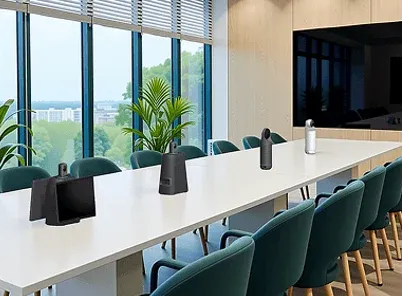
TODO — Financial services
TODO — Replace with a real project: what the client had, what was failing, what you specified and why that brand, and what measurably changed afterwards.
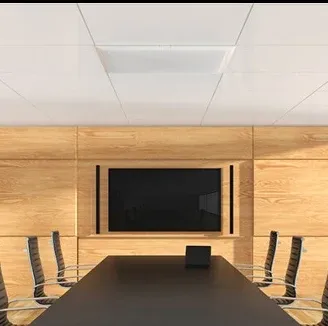
TODO — Legal
TODO — Replace with a real project. Include the constraint that made it difficult, because that is what makes a case study persuasive.
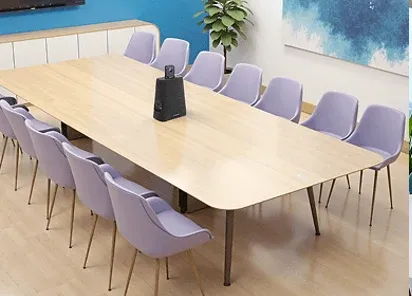
TODO — Education
TODO — Replace with a real project, ideally one where you recommended against the obvious or more expensive option.
TODO — a real client quote belongs here. The most useful kind describes the problem before you arrived and what specifically changed, not a general compliment.
After handover
Firmware moves, certifications change, and rooms drift out of the state you commissioned them in. Someone has to own that, in writing.
Room systems report health, firmware state and usage to one dashboard. We usually see a fault before your staff do.
The person who commissioned your rooms supports them. No first-line script, no re-explaining the estate.
TODO — state your real SLA: four working hours for contracted sites, next business day otherwise, or whatever is accurate.
Firmware roadmaps, certification changes and end-of-life warnings ahead of the renewal conversation rather than during it.
Questions
We carry ten manufacturers precisely so we are not forced into one. If the right answer for your room is a brand we do not hold, we will say so, and we will still help you scope it.
TODO — give a real indicative range per room type. Buyers screen out vendors who will not indicate budget, and a range costs you nothing.
Often, yes. A site survey establishes what is still certified for your platform and what is holding the room back. Reusing what works is usually cheaper than rip-and-replace.
TODO — state real lead times for a single room and for a multi-room rollout, including procurement lead time.
TODO — confirm which markets you deliver in directly and where you work through partners.
We do, under your support agreement. Rooms are monitored remotely, and the engineer who commissioned the room is the one who attends it.
Start here
A room assessment is a conversation and, if it is useful, a site visit. No obligation and no specification until we have seen the space.